Pages

Showing posts with label ship. Show all posts

Monday, 27 January 2014

Naval Surveillance Radar – See the Unseen

Asia military powers have in the last 50 years developed rapidly in term of economy hence permitting them to boost in military expenditures. The protection of territorial waters has required every country to acquire a certain number of naval assets, performing as littoral guardians, resisting incoming threats and at the same time protecting the country’s sovereignty. Naval ships, executing operations in the endless, unpredictable waters, are prone to assaults by various means be it from the air, surface or the hardly detectable underwater threats. Low speed, low manoeuvrability prohibits these naval ships from evading attacks by sources of higher speed and greater capability. It was during the Battle of Britain, when the British became the first force to initiate the wide spread use of the radar, after a thorough study and development process, to detect approaching German aircraft. Coined from the term Radio Detection And Ranging, radar technology was developed many years before and during the World War II. The induction of radars marked the point in history where humans started to rely on technology to enhance their sensory power. Radar, at its best has become the eye to see and the nose to smell, detecting presence of enemies within its range. This, to a greater extent has allowed naval ships to execute operations, be it during the dark, gloomy night or the less permissible dreadful weather. Radars, having been through rapid development since its introduction, has played an important role in defence against multiple threats thus lifting it to a status feared by enemies. Naval powers today rely almost fully on radar detection efficiency, which resulted in limitation of the possibility of errors normally made by human operators. ASPAC Defence - Defense aims at products offered by a few manufacturers of the most modern, latest-generation naval surveillance radars.

Artisan 3D

BAE Systems has initiated the Artisan 3D radar programme, as an integration package for the Royal Navy. Operational onboard the Royal Navy Type 23 frigates, the Advanced Radar Target Indication Situational Awareness and Navigation or known as Artisan 3D has become a superior surveillance radar, capable of imaging objects as small as a bird travelling three times greater than the speed of sound. The radar was designed with a compact and light configuration, contributing to the fact that the radar system weighs only approximately 700kg, allowing installation crew to mount the system within a three-week duration. According to BAE Systems, despite the fact that the radar is small in size, it has the capability to operate through very high signal traffic, as high as 10,000 conflicting phone signals.
Designed to operate on the E or F band frequency, with an outstanding maximum detection range of 200km, the Artisan 3D is capable to efficiently detect fast inshore attack craft, small aircraft as well as panoply of surface and air threats.
Functioning on its primary sensor role with 3D tracking capacity, the Artisan 3D is capable to detect more than 800 targets simultaneously, providing a critical, tactical situational awareness for operator’s safety evaluation and defence mechanism. This generally pictures the radar’s ability to perform in littoral environments, the place where war is more likely to take place and problems most likely to surface. Designed as a software centric system, Artisan 3D helps to boost upgrades capability thus eliminating any necessary costly hardware change. The system’s absolute accuracy and anti-jamming capability, according to the Royal Navy has brought the £100 million procurement into the next stage with proposals of retrofitting the system onto the Royal Navy Type 26 frigates.

RAN-30X/I

For years, Selex has become one of the leading manufacturers of technologies for defence systems, producing panoply of products developed to fulfil security needs of many armed forces. The stages of designing, developing as well as production of defence equipments were done with information superiority in mind. Two of Selex’s most successful surveillance radar systems are the RAN-30X/I along with the KRONOS 3D radar system.
Designed to compete in the “surveillance radar” category, the RAN-30X/I has climbed the vertical ladder to place itself among the most accomplished radar system available in the market. Selex has designed the radar with new a structural configuration, allowing for higher operational flexibility and adaptability to different platforms thus requiring minimal set-up time as well as operational cost.
The RAN-30X/I operates on four main roles. It was designed to perform multiple roles as a measure taken in fulfilling naval forces demand for multi-purpose radar. The roles are, Surface and Air Surveillance (mode 1) for small air and surface target detection, Anti-sea-skimmer detection (mode 2), Over the Horizon (OTH) detection (mode 3), and lastly the Helicopter control and navigation (mode 4).
Depending on the different operational mode, the radar, according to Selex has different instrumental range. In mode one at 15rpm, the radar has an efficiency range of 100km, followed by mode two at 30rpm with 40km efficient range. The third mode, with a gradual rotation of 3rpm, the radar scans for threats within a dazzling 200km range and lastly in mode 4, with 30rpm the radar has a range of 25km.
Currently operational onboard the Italian Navy’s “Cigala Fulgosi” OPV Class vessel, the radar is also currently operating on board Thailand’s Pattani class OPV which had successfully conducted an anti-piracy operation in the Gulf of Eden. This achievement, at one stage has marked the radar capability in supporting high-risk and high-stake high sea operations.

KRONOS 3D

Selex also, through its experience in the development of advanced multi-function radar systems has come up with the KRONOS 3D, a C-Band multi-role radar system with full solid-state active phased array antenna. Selex announced that the radar system has a high detection capability within 180km, its maximum efficient range, in order to support and provide ample time for the ship crew to initiate necessary procedure in case of any incoming threat. The KRONOS 3D radar is available in two configurations, the LND (land based) and the NV (shipborne) versions. Currently operational with the UAE and Peruvian Aguirre class frigates, the KRONOS 3D was developed to stand out as a medium-range radar, with the capability to encounter new generation threats in different environments such as the Electronic Counter Measure (ECM), severe clutter environment in blue water operations as well as rigorous littoral settings in brown water environments. As a measure of Electronic Counter-Countermeasures (ECCM), certain features were integrated into the radar system so that the radar is capable to operate within a ruthless ECM environments, minimising the possibility of a defunct radar and detection system.
In 2011, the government of Thailand heralded the procurement initiatives, as a modernisation effort, awarding Selex the contract of supplying a number of KRONOS 3D radar system for its Navy and Air Force. Currently operational with the Royal Navy Air and Coastal Defence Command, the radar system operates through the integration within the air surveillance network of the Royal Thai Navy. Additionally, with more than 20 KRONOS 3D radar system sold worldwide, it is unmistakable that the system possesses its own unique quality, from outstanding sensory capabilities to user-friendly software configuration as well as simplicity of its maintainability.

MRR-3D NG

Thales MRR-3D NG and the SMART-S Mk2 radar systems are currently operational onboard various naval vessels. The MRR-3D NG radar system was introduced by Thales as an effort to set a benchmark for the surveillance radar category. Thales, through its development plan, came up with the MRR-3D NG long range air and surface surveillance radar, retrofitted with multiple capabilities such as tracking and self defence, target evaluation, weapon allocation feature, target classification support, weapon control as well as advanced ECCM features. This radar was developed to operate with top naval powers, fulfilling their demand for the latest, most modern high performance sensory equipments.
Frech Mistral-class Amphibious Assault Vessel, BPC Dixmude (L9015)
As conferred by Thales, the radar operates on G-band frequency with a maximum-instrumented range of 180km. Moreover, the radar has a unique capability that allows it to exploit the duct effect, without compromising data accuracy, therefore providing the radar operators with an advantage of detecting threats and targets beyond its normal range. Weighing less than 500kg, the radar system offers a considerably light package thus making it an ideal choice for small surface combatants while at the same time suits bigger vessels’ operation requirements.
In an event of missile attack, the MRR-3D NG radar projects a dedicated multi-beam pattern in order to provide sufficient data thus minimising the time consumption for target acquisition, providing more time for anti-air weapon system to operate effectively. The radar, proven its capability by Thales, is currently operational onboard various naval ships such as the Norwegian Skjold class fast patrol boat, South African Valour class frigates as well as the renowned French Mistral class amphibious assault vessels.

SMART-S Mk2

The success of the SMART-S Mk2 radar by Thales is marked by the number of procurement awarded throughout the years, basically strengthened by its exceptional features longed by various naval powers all across the globe. While fulfilling the basic attributes of surveillance radar, Thales has, through their development programme enhanced the sensory power of the SMART-S Mk2. One major factor of the radar’s success is the trouble-free utilisation and maintenance throughout its operation life.
Introduced in 2003, the SMART-S Mk2 was principally intended to replace the older generation air-search and target designation radars that back then operates onboard various frigate class vessels. Meant for integration with frigate class weapon system, the radar is programmed to perform in littoral waters, able to conform its operational capability to land clutter and moving coastal objects, which usually resemble alarming threats such as low-flying aircraft and missiles. This in a way helps to reduce errors normally produced on the radar interface, minimising the possibility of command error during any operation.
The radar, developed by Thales Nederland is currently active onboard various navy vessels such as the Karel Doorman class frigates of the Royal Netherlands Navy, Royal Danish Absalon class support vessels, Indonesian and Moroccan Navy Sigma class corvette and the Khareef class corvette of the Royal Navy of Oman.

SEA GIRAFFE AMB

Saab, through its radar programme has successfully delivered the SEA GIRAFFE AMB radar, a product designed to suit small combatants such as corvettes and frigates. The radar has been proven effective during various operations within maritime harsh environments. It was successfully awarded the primary role as surveillance radar onboard USS Independence (LCS-2) in its LCS programme, still running today. The radar, through extensive study at initial stage has been chosen thanks to its unmistakable performance and reliable features. The SEA GIRAFFE AMB, according to an official, fulfilled the programme’s desired cost and performed way beyond the expected requirements.
AMB, which stands for agile multi-beam, consists of twelve stacked receiver beams, in support of covering a great volume of altitude. This, in a way helps the radar system to identify targets up to 65,000 feet of altitude with very accurate data provided by the stacked receiver beams. This feature, in a bigger picture provides commanding officer more reaction time against air and surface threats. The radar also has the capability of 70° elevation thus enabling it to efficiently sensors air targets. Air and surface surveillance, tracking and target identification is done simultaneously, eliminating the need of time-consuming manual operation.
In a general perspective, the radar is capable of detecting multiple threats from multiple directions, including fast moving surface-skimming missiles. The radar is able to automatically detect 200 air targets, 400 surface targets as well as 50 jammer emitters in a single time, backed by the optimisation of hard-to-see detection feature designed to perform in severely cluttered environment. In this modern warfare of stealth-ness, Saab has designed the radar to be configured with stealth radome, in order to minimise radar cross-section (RCS) and infrared signature. Having exceeded major expectations of various naval forces, it is unquestionable why SEA GIRAFFE AMB has become the choice worldwide. Other than the USS Independence, the radar is currently serving onboard various vessels such as the Australian and New Zaealand Anzac class frigates, the Canadian Halifax class frigates, Lekiu class frigates of Malaysia as well as the Baynunah class missile corvettes of the UAE.

TRS-3D

The TRS-3D is a standard naval multi-mode surface and air surveillance and target acquisition radar from CASSIDIAN. Designed for the demanding littoral settings, the C-band radar provides excellent performance over land and water, minimising clutter interference in order to more effectively and simultaneously detects various surface and air targets.
The TRS-3D is suitable for installation as the main radar on corvettes, FACs, OPVs while on frigates and larger ships, as main self-defence radar. Supported by its highly flexible design, the TRS-3D radar integrates a variety of shipboard systems and C4ISR suites, enabling it to perform multiple roles including surveillance, weapon fire control and helicopter detection and guidance. Due to the latest signal processing technologies, the TRS-3D is particularly suited for the early detection of small, fast moving objects, such as speedboats and sea-skimmer missiles.
USS Freedom during a visit to Singapore in 2013
EADS North America has received a contract from Lockheed Martin to supply its TRS-3D radar for the US Navy’s Littoral Combat Ship programme, which is currently undergoing operations in the South-East Asia. As part of a recent Department of Defense award, Lockheed Martin will construct up to 10 Littoral Combat Ships through 2015. USS Freedom completed its maiden deployment in 2010, which included the successful interception of drug vessels in the Caribbean. In addition to the US Navy’s fleet, EADS North America also is providing the TRS-3D radar to the US Coast Guard for its fleet of National Security Cutters, of which three are in operation and two more are in the process of integration.
The radar system is also installed onboard Kedah class OPVs, Bremen class frigates, Braunschweig class corvettes, Nordkapp class OPVs, Svalbard class artic OPV, Flyvefisken class patrol vessels (in combat role), Hamina class missile boats, Ambassador MK III class missile boats as well as the new Finnish Border Guard's new OPV.

SCANTER

L'Adroit OPV
As a Danish defence and aerospace manufacturer, Terma has made it presence felt in the defence industry with numbers of procurement initiatives heralded by many top names. They have introduced the Scanter radar system, which was retrofitted onboard the L’Adroit OPV of the French Navy. The radar was specifically designed with small target detection capability, as a measure against littoral threats such as drug trafficking, smuggling, piracy and terrorism. Designed as an affordable package, the system is capable to prevent major problems normally faced by commercial radars. Performing as a versatile and modular based system, the radar is able to fulfil various needs by its operators. All features are tailored to meet customers’ demands, which in a way proves its flexibility. These features, in a bigger picture portrays that the radar system was given full attention throughout its development process, focusing on littoral environment utilisation. Compared with systems with higher transmitter power, the SCANTER radar system definitely provides more advantages to its operators. By producing lower transmitter output, this in a way assists operators to avoid any jamming attempt by threats around it, preventing a defunct radar system, which is able to expose the ship to greater danger.

Thursday, 23 January 2014

Joint Logistic Support Ship – The Strongest Link In The Supply Chain


This article was written in September last year. The ship has since undergone a few significant events. It first controversially went on sale due to budget cut by the Dutch MvD and the Canadian government has shown interest to purchase the newly built ship. However, in October last year, the Dutch MvD has reversed the planned cut after receiving EUR 115million funding. To overcome budgetary issue, HNLMS Karel Doorman will operate with reduced crew size. 

UNREP, a term coined from Underway Replenishment has constantly become one of the most critical element in the endurance of any naval operation. The growing trend for naval fleets to operate far from home waters is making UNREP more necessary than ever. International operations, such as the Combined Task Force 150 (CTF-150) in the Gulf of Aden requires the presence of UNREP ships so that combatant ships can remain on station for extended periods. The history of at-sea-replenishment has highlighted the importance of having excellent multi-role UNREP support. Although the single-role concept was proven very successful, they are now becoming more and more obsolete thus many naval forces today eliminated the single-role concept for food, fuel and ordnance supplies. Budget restrictions, as well as the requirement of smaller fleets with superior capabilities has consequently resulted in the retirement of these worn out logistic ships hence the introduction of the new, multi-role, Joint Logistic Support Ship (JSS).

Genesis of the JSS

The Royal Canadian Navy (RCN) was the first to initiate the concept of JSS in 2004 when they announced the contract for the construction of two vessels under the JSS category. Under the contract, the RCN would have expected one ship to be fully operational by 2012. However, in August 2008, the Minister of Public Works and Government Services announced the termination of the procurement contract of the highly anticipated JSS. The whole progress was put to a halt pending July 2010 when the Defence Minister of Canada announced the purchase of two JSS, with a value estimated at USD2.8 billion.
In December 2009, while the Canadian procurement contract was at a standstill, the Netherland’s Defence Materiel Organisation (DMO) and Damen Schelde Naval Shipbuilding (DSNS) heralded a contract for the supply of a JSS. The ship, named Karel Doorman, was initiated as the replacement ship for the HNLMS Zuiderkruis, a Royal Netherlands Navy (RNLN) logistic ship, which has been operational for the past 34 years. The ship is fundamentally designed as a multi-role platform to enhance the RNLN’s logistic strength, to function as a multiple platform, from maritime support, strategic sealift to sea-basing mission in blue and brown water environments.
According to DSNS, construction of the ship’s main structure largely takes place at Damen Shipyard in Galati, Romania. The ship’s keel was laid down in June 2011 by RAdm K. Visser and while this article is written, JSS Karel Doorman has completed its three-week journey from Romania to DSNS in Vlissingen, Holland for completion including systems outfitting, commissioning and testing. The JSS is due to be rolled out in July 2014.


Stronger Logistic Muscles

The JSS is a multi-role logistic ship, measuring 205 metres long and 30 metres wide. The Royal Netherlands Navy’s 28,000 tonnes JSS Karel Doorman is designed to accommodate at least 300 personnel, consisting of 150 crewmembers and 150 non-listed members that include helicopter crew and medical teams. The huge build-up contributes to JSS Karel Doorman’s ability to accommodate multiple extensive facilities including a bigger hangar, a bigger helicopter deck and also a more comprehensive hospital facility.
In the hospital configuration, the ship allows for more complex hospital operation, capable of providing diagnosis, treatment as well as holding of patients needing and receiving total treatment. In disaster relief mode, the ship is furthermore able to accommodate a large number of evacuees, fully utilising the hospital space. This, in a whole, provides the ship with greater reaction time in an event of a disaster.
Meanwhile, to achieve superiority in the logistic category, the ship is equipped with a deck area measuring 2000 lane meters, providing enhanced room for cargo roll on-roll off (RORO). Fully loaded, the ship is able to carry as much as 8000m3 of fuel, 1000m3 of helicopter fuel, 450m3 of potable water as well as 400 tonnes of ammunition. In addition to that, for loading and unloading purposes, the ship is equipped with two Replenishment-At-Sea masts, an elevator and a crane capable of handling 40 tonnes of loads. This ship too, is equipped with a RORO facility and a steel beach stern for easier transport of landing craft.
Aft of the ship is a helicopter deck, easily recognisable by the open wide space, large enough to enable two helicopters as big as a Chinook to operate simultaneously. For helicopter storing purposes, JSS Karel Doorman is built with a very large hangar that can house as many as six NH-90 helicopters with folded blades or two Chinooks, both with full-extended blades.

Thales I-Mast Goes Seaborne

On March 2010, DMO and Thales Nederland have signed a contract for the construction, delivery and installation of the I-Mast on the JSS. The DMO has opted for the I-Mast 400, a system similar to the one installed on RNLN’s four Holland-class Patrol Ships.
JSS Karel Doorman, is currently undergoing tests using a Thales I-Mast system that is reportedly borrowed from the RNLN’s new Holland-class OPV. Delivery and installation of the I-Mast on board JSS Karel Doorman is set to take place January 2014.


Thales I-Mast 400
The I-Mast system offered by Thales is an all-in-one mast concept, a structure built meticulously to house various sensory equipments including radar, optical-electronics, communication devices, antennas, cabinets as well as many other peripherals. The introduction of the one mast concept minimises the need of more costly and complex power supplies, structure adaptations, electrical interfaces as well as cabling and cooling systems.

The whole system consists of a Seamaster 400 SMILE air warning radar, a non-rotating phased-array S-band radar with four faces that is derived from the SMART and APAR radar systems, Seawatcher 100 active phased-array surface detection and tracking radar, a non-rotating active phased-array I-band radar for naval surface surveillance and the Gatekeeper infra-red/electro-optical warning system, a 360° panoramic electro-optical surveillance and alerter system based on IR/TV technology.


Integration of Advanced Firepower

The fact that the JSS is merely a logistic ship does not prevent the RNLN to boost its firepower. Focusing on defensive equipment rather than offensive, JSS Karel Doorman is armed with considerably heavy countermeasures against inbound threats. To begin with, the JSS is armed with a pair of Thales Nederland’s 30mm Goalkeeper 7-barrel gatling gun systems along with Missile Piercing Discarding Sabot (MPDS) ammunition. The system, which is built with dedicated search and track radar, is meant to provide the much-needed resistance against surface threats. Operating on I-band, the system is able to detect targets in all weather conditions, and furthermore backed by the I/K-band track radar for a continuous track-while-scan mode to engage multiple threats at the same time.
Next in the defence line are two Oto Melara’s Marlin WS 30mm naval guns. Adding to the two previous guns, four Oto Melara’s Hitrole NT systems are going to be installed. These 12.7mm small calibre machine guns can be remotely operated and normally assigned within a ship’s secondary defence line. Operating through optronic sensors, the system can also be connected to the ship’s Combat Management System.

Oto Melara's Hitrole NT
JSS Karel Doorman is also set to carry four Super Rapid Blooming Off-board Chaff (SRBOC) systems. The SRBOC stand as the ship’s only soft-kill protection system, generating decoy patterns and providing full screening for the ship.
The JSS Karel Doorman features comprehensive ASuW suites, including self-defence mechanism against seaborne threats including missiles, combat aircraft and helicopters. Its defence features have way surpassed its predecessor, the HNLMS Zuiderkruis, which during its service life was only armed with a single Goalkeeper system and two manned 12.7mm gun stations.

Propelling Forward: The Propulsion System

Rolls Royce will supply five Bergen diesel generators, comprising of four 5.5MW and one 2.8MW generator, which totals up to 24MW. DSNS too has awarded a procurement contract to Converteam, or later known as GE’s Power Conversion for the supply of two main electric motors. In the contract, Power Conversion will also supply the ship’s thrusters electric systems and an Energy Management System.
Looking at the main propulsion system, the RNLN has decided to use the conventional configuration of rudder and fixed pitch propeller. Powered by two 9MW electric motors, JSS Karel Doorman is capable of cruising at a maximum speed of 18 knot. For easier manoeuvring in limited space, the ship is equipped with two 1.25MW thrusters at the bow and a single 0.75MW thruster at the stern. These thrusters act as the ship’s auxiliary propulsion system, enabling it to move port and starboard thus providing a logistic solution for the ship’s operation.

Economic Challenges Ahead

Soon to be commissioned as a frontline logistic platform, the JSS is anticipated as the RNLN’s logistic delivery capability of the future. While combatant ships are receiving more complex and advanced technological suites, logistic ships such as JSS Karel Doorman albeit less complex, are built with immense capability. Being a part of future naval system, naval ships generally or specifically the JSS Karel Doorman is expected to perform way beyond its original capability.
Therefore, the RNLN is taking one step ahead of its potential opponents with the integration of advanced technologies in all aspects including logistic, self-defence and communication and sensory systems. Since this has cost the government a lot of money, the expectation of this super-expensive naval asset is high in the air. Global recession as well as many other economic contributing factors has occasionally put pressure on both the public and private sectors. While the public sector is facing budget constraints, the private sector, the contractors to be specific, are facing challenges in gadgetry development as well as time constriction aspect.
With navies tendency to deploy ships far from home waters for international operations such as the CTF-150, one should expect to get the most out of this expensive sea-going ship hence operational ability and capability remains the main issue. The RNLN, eagerly expecting the JSS Karel Doorman, is anticipating challenges in the future, especially in current economic setting in order to maintain the equilibrium of cost efficiency and operational capability.


 A Look At The Not-So-Distant Future

Marked by the arrival of JSS Karel Doorman in her homeland in Vlissingen, the Netherlands, the RNLN is expecting some momentous events in the future. It will begin with the integration of the I-Mast 400 by Thales Nederland, which is going to take place somewhere in January next year.
On May 2014, JSS Karel Doorman is set to undergo the first phase of its sea trial and the handover ceremony between DSNS and DMO later in July next year. Right after the handover ceremony, a number of tests will be conducted, as well as the commencement of refinement period for the ship and her crew.

The commission of JSS Karel Doorman, as planned, is due mid 2015 and it is to enter service and revive the duty of its predecessors, HNLMS Zuiderkruis, decommissioned 2012 and the HNLMS Amsterdam, which will be decommissioned in 2014 respectively. On the day of its inauguration, the JSS will officially bear the name, HNLMS Karel Doorman and A883 pennant number as a mark of its role as the RNLN’s primary auxiliary ship. 

Wednesday, 22 January 2014

Naval Helicopters: An Overview of Asian Latest Fleets


Naval helicopters, as it is termed, are specifically built for military sorties in the open sea. Sometimes known as maritime helicopters, these rotor-winged aircraft are used as a mean of troop transport, combat search and rescue operation (CSAR), medical evacuation (MEDEVAC) as well as combat purposes. These helicopters, exclusively intended for specific missions, are categorised into different categories such as tactical helicopters, surveillance helicopters as well as anti-submarine helicopters.
The induction of naval helicopters, onboard warships, has to a great extent, enhanced navies’ operational efficiency. While modern helicopters are able to carry out multiple types of missions, naval helicopters of the early days were assigned solely as plane guards, tasked to discover and recover aircrew of ditched plane and helicopters throughout an aircraft carrier flight operation.
The advancement of technologies saw manufacturers producing helicopters equipped with integral dunking sonar, advanced radar system plus magnetic anomaly detection equipment which in turn enabled manufacturers to assemble helicopters with a higher payload capacity and longer endurance. Helicopters are now able to function with less dependency on parent and other warships.
To date, all naval helicopters are finely equipped with most advanced avionics, efficient and powerful engines, precise and lethal armaments as well as adequate protection against the unforgiving sea conditions especially salt water corrosion. ASPAC Defence looks at a number of naval helicopters in service or about to enter service across the Asia-Pacific.

Sikorsky MH-60R


The MH-60 of R variant from Sikorsky, designated as “Seahawk” was originally referred as “LAMPS Mark III Block II Upgrade”. The helicopter, according to Sikorsky was designed with combined quality from the SH-60B and SH-60F helicopters, producing a multi-role helicopter capable of handling missions in anti-submarine warfare (ASW), anti-surface warfare (ASuW), CSAR and MEDEVAC.
Kitted with the deadly Mk-54 active homing torpedo, the MH-60R is a great force against sub-surface threats. The new MH-60R warfare sensor has made it a game-changer. Retrofitted with the new AN/APS multi-mode radar, MH-60R is capable of displaying ten times the number of tracks compared to the previous system and the Electronic Support Measure (ESM) system has a passive capability that provides greater accuracy compared to earlier versions.
The equipment of these state-of-the-art technologies has put the MH-60R into a leading naval helicopter, with thousands of logged operation hours with the US Navy. Powered by two General Electric T700-GE-401C turbo-shaft engines, each producing 1911shp, the MH-60R is able to reach a maximum flight speed of 144 knots (267 km/h). Adding up to that, pilots instrumentation are configured with digital displays that resemble the glass cockpit of the MH-60S, another variant of the Sikorsky SH-60 Seahawk helicopters.
Australia, on 2011 has announced the procurement of Sikorsky’s MH-60R for the nation’s defence force’s requirement, a demand for a fleet of 24 new-generation multi-role naval combat helicopter. Upon deliveries, Sikorsky will put up their plan to bring long-term jobs and work opportunities to the Australian industry, which is estimated to value at USD1.5 billion. Sikorsky added that the Royal Australian Navy is expected to take delivery of the first MH-60R beginning 2014. In addition to that, the Republic of Singapore Navy has recently ordered an additional two units of the S-70B helicopters to add to the six already in service with delivery expected to take place in 2016 while the Royal Brunei Air Force is due to receive their S-70i Black Hawk by the end of this year, ahead of its schedule time. The twelve RBAF helicopters are expected to carry out maritime duties as well.

AgustaWestland AW159


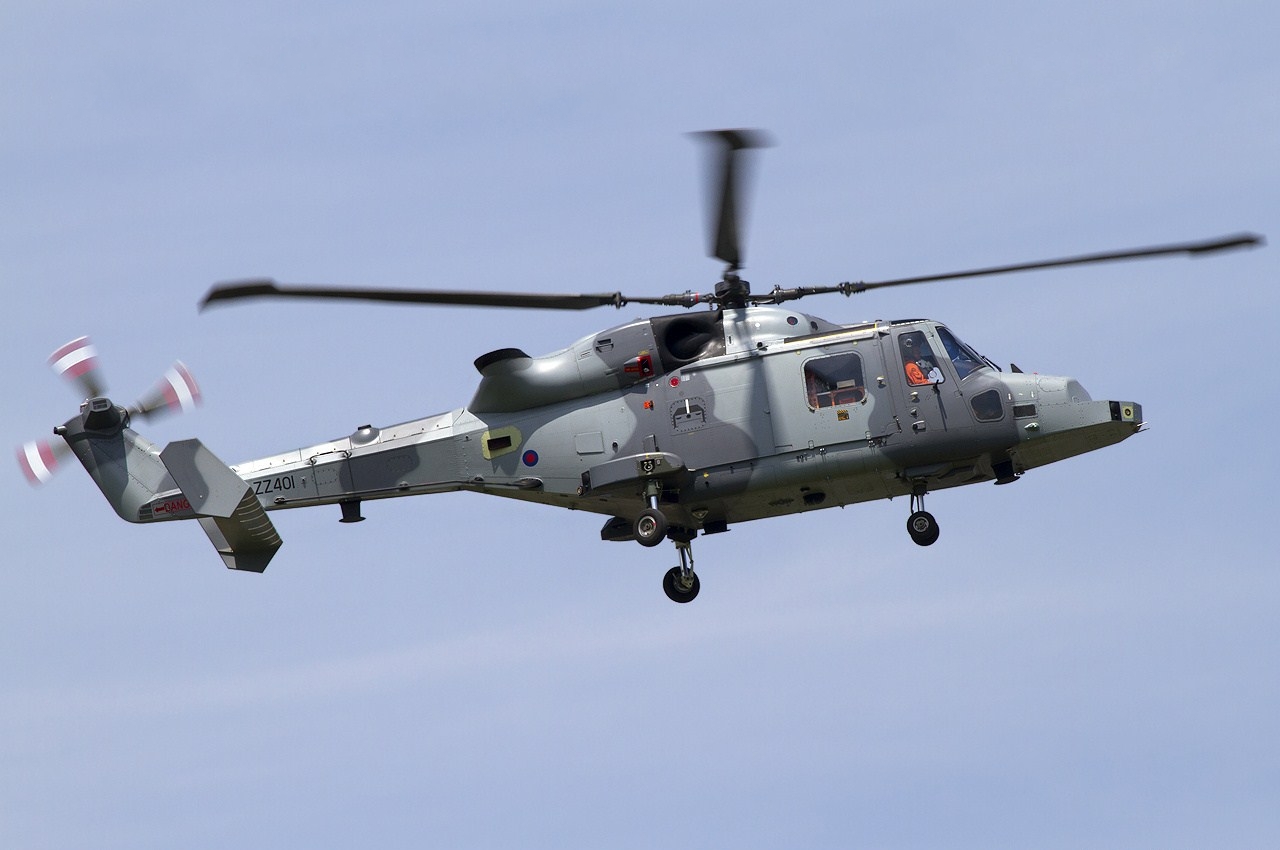
The AW159, earlier acknowledged as Future Lynx or the Lynx Wildcat, is a new generation naval helicopter, first inducted into the British Army and Royal Navy services. The helicopter, an improvised version of the top-notch Westland Super Lynx was manufactured for hazardous battlefield deployment, CSAR mission as well as ASuW.
AW159 comes out of assembly line equipped with a semi-rigid rotor head that contributes to the helicopter’s high agility, matching the operating capabilities of the legendary Lynx helicopter. In addition to that, AgustaWestland also fits the helicopter with high performance composite rotor blades, which at one point of history assisted the Lynx helicopter to break the world helicopter speed record.
The helicopter is driven by two LHTEC CTS 800-HN engines, each producing 1361shp, with the ability to operate in hot and high environment. Aircrew operation also is moreover succored by the integration of four 10”x8” cockpit displays combined with up to date, fully integrated avionics. AgustaWestland has as well made a decision to manufacture the AW159 with anti-ship missiles, torpedoes and door-mounted guns, specially fitted for combat purposes.
The government of South Korea, on Jan 15 heralded the procurement of AW159 to fulfil its Navy’s requirement. The selection, according to the Royal Navy, will strengthen their bilateral relationship with the Korean counterpart. Deliveries which are expected to commence in 2015 until 2016 will see the helicopter equipped with various cutting-edge technologies including active dipping sonar, 360 degree scan radar, nose mounted electro-optical device and a rescue hoist.


AgustaWestland Super Lynx


The Super Lynx, a multi-role, multi-mission maritime and utility helicopter by AgustaWestland is presently operational with various world leading armed forces, a proven fact of its ability to outnumber other helicopters of similar class. Built with fully-marinised airframe, the helicopter was designed to withstand the harmful salt-water corrosion during rigorous sea-operation conditions.
With small ship deployment in mind, the helicopter was primarily designed with exceptional features including lower centre of gravity, foldable blades and tail for trouble-free storage as well as a mixture of other rugged characteristics. In order to operate within the harsh maritime environment, AgustaWestland came up with the resolution to fit the Super Lynx with two LHTEC CTS800-4N engines, generating 1361shp capacity, boosted by a single engine capability. This, in a larger picture, helps support the helicopter’s operation ability in a demanding hot and high condition deployments.
The Super Lynx is technically equipped with an advanced Night Vision Goggle (NVG) compatible cockpit, integrated avionics suite as well as an array of optional equipments, meant to enable the helicopter to deliver day and night, all-weather ASW, ASuW and CSAR missions. The technologies that come along the Super Lynx have been proven to support numbers of autonomous operation in detecting and prosecuting targets.
Members of ASEAN countries such as Malaysia and Thailand have chosen the Super Lynx as their superior naval helicopter, with six currently operational in the Royal Malaysian Navy and four in the Royal Thailand Navy. The helicopter, along other naval assets has become a key player in maintaining maritime sovereignty for both countries alike.

Eurocopter EC725


The EC725, a top of the line helicopter by Eurocopter, also named the Super Cougar is a long-range tactical transport helicopter, in the beginning developed from the long-standing Puma family. Surprisingly, despite the primary purpose of land operation utilisation, the EC725 has become a popular naval helicopter thanks to the various developments and upgrades by Eurocopter.
Derived from the civilian EC225 model, Eurocopter has deliberately built the EC725 for military use, with a twin-engine configuration along a spacious cabin, capable of transporting up to 29 soldiers. Despite the noticeably large size, the Super Cougar was designed to perform multiple types of mission including MEDEVAC and CSAR.
In support of security and self-defence, the EC725 is equipped with expanded weapons load including two 7.62mm FN MAG machine guns, an option of two 68mm Thales Brandt or Forges Zeebrugge rocket launchers, two 20mm GIAT cannons and also the Dassault Electronique EWR-99 FRUIT RWR radar warning receiver. These armaments were intended to come along the helicopter to ensure higher survival ability in dangerous combat environments.
At the heart of the helicopter are two powerful Turbomeca Makila 2A1 turboshaft engines featuring a dual-channel Full Authority Digital Engine Control (FADEC) system. Driven by both engines, the helicopter is capable to cruise at a speed of 285 km/h with an outstanding efficient range of 1339km. The EC725, according to Eurocopter, can also be optionally equipped with an anti-icing system, a key feature meant to support very cold climates operation.
Catered for the crew is an integration package of advanced multi-display cockpit consisting of a hi-tech display system featuring a digital map as well as the Active Matrix LCD system. In addition to that, the Forward Looking Infra Red (FLIR) equipped in the helicopter enables the EC725 to perform day and night CSAR.
The EC725, which has proven its capabilities with the Brazilian and the French armed forces, is now operational in the Royal Malaysian Air Force. Currently in manufacturing stage for the Indonesia Air Force and Royal Thai Air Force, the EC725 is set to be delivered circa 2014 and 2015 respectively.

Bell 412EP


With the introduction of the 412EP model, Bell has once again made its presence felt, with purchase agreements by more than 20 countries, surpassing most of its competitors in term of sale revenue.
The Bell 412 was developed during the 70’s when Bell converted the up-and-flying 212 model into the 412 prototype. From the two-bladed 212 model, Bell has radically altered the helicopter with the integration of the four-bladed rotor thus producing the latter version, the 412 type and it was until recent years that Bell came up with the 412EP (Enhanced Performance) model.
Featuring the trademarked BLR Strake and Fast Fin systems, the 412EP model has proven its ability to deliver improved hovering ability in crosswind as well as hot and high conditions. This is added with low fuel consumption, a characteristic very important in this critical period when even the richest country is cutting on military expenditure. Pratt & Whitney was awarded the responsibility to supply their engines for the 412EP helicopters and they came up with the PT6T-3DF Twin Pac engines offering guaranteed Time Between Overhaul (TBO) of 4000 to 5000 hours.
Bell 412EP, through the enormous 2.3 metres door opening has made soldiers and equipment transportation easier. Added with ergonomic seating configuration, the 412EP is able to accommodate 15 soldiers, including two crewmembers. These characteristics, along with the adoption of rupture resistance fuel cells, energy absorbing crew seats as well as the collective mounted throttles has enabled Bell to produce a helicopter with greater and higher safety limitations.
The Bell 412EP, introduced as a multi-purpose utility helicopter, has a capability to cruise at a speed of 226 km/h with a maximum flight range of up to 980 km. Weighing slightly less than three tonnes, the helicopter is a good option for fast and light utilisation. Latest update in the ASEAN region saw the Indonesian army receiving six Bell 412EP helicopters with an addition of 16 units of similar model with deliveries expected to complete by the end of 2014. Currently, the Bell 412EP is operational with various armed forces including the Philippines, South Korea and Thailand.

AgustaWestland AW109


The AW109 is a lightweight, twin engine, eight-seater, multi-purpose helicopter built by the Anglo-Italian manufacturer AgustaWestland. Introduced in 1971 as A109, the helicopter has proven itself in light transport, MEDEVAC, CSAR and various military roles.
Initially a civilian helicopter, the A109 has gone through various modifications and upgrades in fulfilling the ever-challenging military demands consequently resulting the introduction of the AW109. AgustaWestland has come up with optional engines, either the Pratt & Whitney PW206C or the Turbomeca Arrius 2K1, both supported by FADEC system.
The system, supported by a digital glass cockpit consisting of six digital LCD instrumentation with modern softwares has help to reduce pilot workload, which in a way grants them the essential time and space to focus on mission execution. Categorised in a three-tonne class, the helicopter has a considerably spacious cabin mainly designed to fit numbers of modular equipments for an easy and timeless conversion between roles.
Safety measures, like any other helicopter manufacturers, were critically taken into consideration therefore resulting the decision to include a fully separated fuel system for less fire risk, dual hydraulic boost system, dual electrical system as well as redundant lubrication and cooling system for main transmission and engines.
AgustaWestland has additionally reinforced the landing gear on all AW109 model for a safer and long-lasting shipboard operations. Extensive corrosion protection is not left out to ensure the helicopter’s robustness in maritime settings. These improvements underline the AW109 ability to perform missions in extreme weathers and environments.
To date, the Philippine Navy, which is going through modernisation initiatives, has agreed to purchase three AW109 in a process of boosting its maritime security and disaster response capabilities. The purchase comprises personnel trainings added with initial logistic support amounting to USD 31.7 million. The decision, according to the Philippine Navy, was made on many aspects, mainly of its cost-effectiveness. Delivery is set to take place in 2014.

Eurocopter AS555 Fennec


On January 2011, the Royal Malaysian Navy PASKAL commandos have executed a recovery mission on a hijacked Malaysian tanker with remarkable success, supported by the Fennec helicopter. The mission, conducted against the brutal Somali pirates, saw the Fennec acted as reconnaissance and aerial guardian to keep the pirate’s ship away from the combat scene. The event made into news headlines worldwide, with the Fennec portrayed as a key player during the event.
The AS555 Fennec is a multipurpose military helicopter, manufactured by Eurocopter primarily for navies’ utilisation. The helicopter was at first designed based on the AS350 Ecureuil and AS355 Ecureuil 2 series and later named Fennec, after the Fennec Fox.
Weighing around 2.8 tonnes, the Fennec is powered by two Turbomeca Arrius 1A turboshaft engines, rated at 415kW readily equipped with the FADEC system, enabling the helicopter to perform automatic sequenced engine starting. Eurocopter has also included two integral fuel tanks; with 1202 litres fuel capacity, allowing a maximum flight range of 695km.
Beyond that, the helicopter can also be fitted with a wide range of weapons load to fulfil mission and operation requirements of many armed forces. The weaponry include missiles, rockets and guns such as the Forges de Zeebruge rocket launcher carrying seven 2.75in rockets and the Thales Brandt 68mm launcher carrying 12 rockets. For ship borne operation, the helicopter comes with ASW and over the horizon (OTH) targeting features, as well as a chin-mounted Telephonics RDR-1500B X-band, 360-degree digital colour radar, for search and surveillance application.
In favour of crew operation support, the helicopter is provided with a night vision compatible cockpit. This, despite being a common feature in most naval helicopters, is furthermore adjoined with the Thales Avionics Nadir 10 navigation system, a Sagem 85 T31 three-axis autopilot and Thales Detexis RDN 85 Doppler radar.
The AS555 Fennec 2, having served the Royal Malaysian Navy for the past nine years as multi-role training helicopter is now still operational, and its newer generation, the AS550 is in operation with the Pakistan Navy while some are currently in production for the Royal Thailand Navy.

Eurocopter AS365 Dauphin/ Harbin Z-9


Dauphin helicopter is a renowned rotary-wing aircraft, having served some of the world biggest armed forces including the USA and India. Derived from the single-engined, Aerospatiale’s SA 360 Dauphin variant, the helicopter has build up its reputation as corporate transport, airborne law enforcement platform, emergency medical services (EMS) helicopter, electronic news gathering platform as well as SAR helicopter.
The helicopter, assigned as navy’s multipurpose helicopter, has gone through rigid developments, for example the integration of two Turboméca Arriel 2C engines, accumulatively producing more than 1600shp. The engine capacity contributes to the helicopter’s performance, with manufacturer maximum speed limit of 165 knots (306 km/h). The helicopter, weighing approximately 2.5 tonnes is capable to cruise to a total distance of 827km with the service ceiling limited at 5865 metres.
The Republic of China, through legal licensing process by Aerospatiale, has been given the rights to produce helicopters based on the original AS365 Dauphin model. They came up with the Harbin Z-9, a total resemblance of the original model. Through self-research and development, newer Z-9 models have been fitted with composite materials to increase structural strength as well as producing lower radar signature.

To date, the AS365 Dauphin/ Z-9, despite the introduction way back during the 70’s are currently still in production with demands by many civilian bodies and armed forces around the globe. Record shows that the Dauphin/ Z-9 helicopter is currently operational with various Asian navies such as Australia, Bangladesh, Malaysia, Saudi Arabia, Sri Lanka, Laos and Pakistan.

Naval Surface to Air Missiles in Modern Warfare Insecurity

It is not an overstatement that air defence remains one of the most critical elements in ensuring a ship’s survival in the battlefront. The agility in performing evasive manoeuvres coupled with adequate counter-measures promises a ship’s survival-ability in the open sea.
We are going through the period where rich nations are radically arming its armed forces with lethal offensive capabilities. Through the procurement of 5th generation combat aircraft, they are poised to flex their air-superiority muscles thus urging the need for necessary air defence measures by neighbouring countries.
In order to overcome the possibility of overwhelming air threats, navies around the world have initiated a series of modernisation efforts through various enhancements and development of onboard defence systems. The modernisation programmes include the upgrade of radars, firepower and necessary armor. While radars and armors stands as a passive defence measures, the equipment of stronger firepower onboard ships ensures one ability to generate offensive measures against not only aerial threats, but also against surface and underwater threats. ASPAC Defence brings you about a number of latest naval surface-to-air missiles currently serving navies around the globe. 

Aster 15/30


The Aster missile family, namely the Aster 15 and Aster 30 were inaugurated in 1989 when France and Italy signed an MoU on the development of indigenous surface-to-air missiles. Development took place up until October 2002 when Aster first went into service onboard French aircraft carrier, Charles de Gaulle. Developed based on the Principal Anti-Air Missile System (PAAMS) as well as the Surface-Air Anti Missile (SAAM) system, both Aster 15 and 30 were designed to perform air defence manoeuvres, especially in anti-ballistic roles. Operators of the Aster missiles may boldly rely on Aster missiles’ capability of countering ballistic missiles upon target’s re-entry.
Aster 15 and 30, though both operate on Vertical Launching System (VLS), differs in a few significant characters. While the slightly smaller Aster 15 is capable of engaging targets to a range of 30km, Aster 30 has a longer range in excess of 100km. Having an effective altitude of approximately 13km, Aster 15 has an engagement speed of around Mach 3 while Aster 30’s speed tops at Mach 4.5 with maximum altitude of 20km. Thanks to its larger build up, Aster 30 is able to accommodate larger booster stage hence the superiority in range, speed and altitude compared to the smaller Aster 15. Both missiles are steered using PIF-PAF system, which enables them to handle 60G during flight as well as preventing structure rupture in an event of trajectory corrections.
Aster 15 and 30 each is equipped with active radar homing, enabling them to identify and maintain target engagement during trajectory. Both missiles were designed to suit Sylver missile systems, namely the A-43, A-50 and A-70 variants or several other platforms of similar size such as the Mark 41 VLS. Aster 15 is available in only single variant while Aster 30 has been developed into four variants including standard Block 0, Block 1, Block 1NT (New Technology) as well as Block 2. Block 1 is Aster 30’s land version for protection against 600km-range ballistic missiles, while Block 1NT is set to perform counter-measure against 1000km-range ballistic missiles. The later is to provide defence against 3000km-range ballistic missiles.
Since its inauguration, the Aster missile family has been widely selected by several leading armed forces in the world. Having served its home nations, France and Italy, Aster missiles have also known to serve the Royal Navy, Singapore Navy as well as Saudi Arabian Navy.


Aspide 2000


Introduced as MBDA’s medium range surface-to-air missile, Aspide 2000 went through R&D and upgrades based on Aspide multi-role missile platform, with the anticipation of 40% performance increase compared to its predecessor. Aspide 2000 is available for sea and land operation, maximising its potential for global operators. Unlike the Aster missiles, Aspide 2000 is only equipped with the commonly used semi-active radar homing thus necessitating additional guidance from external sources. The absence of a higher-tech guidance system is made up by the engagement range, which measures up to 25km. This feature is furthermore enhanced with the missile’s maximum altitude, rated with the ability to strike targets cruising 3.5km above ground.
Aspide 2000 operates on a number of platforms including Albatros, Spada, Skyguard as well as Amoun. These systems consist of both naval and land platforms, readily available for armed forces all over the world. Aspide 2000 missiles are currently in service with armed forces from Egypt, Pakistan and Spain. In addition to this, the missile too, is also supporting Italian Air Force and Royal Thai Air Force as part of their Skyguard air defence system. Kuwait is the latest nation armed with Aspide 2000. Following an order of upgrade on its older Aspide missile system, Kuwait has since received the system and executed a series of exercises and trials. Since 2007 pending January last year, Kuwait has successfully launched 19 Aspide 2000 missiles in varying weather conditions. During the January 2013 exercise, Aspide 2000 has accomplished a major milestone, having neutralised two remotely flown Banshee aircraft. The milestone has proven Aspide 2000’s capability and its potential to form a part of a reliable air defence system. It is not an overstatement that Aspide 2000 can be perceived as one of the best option to fill the gap between a long-range missile system and a ship’s gun close-in weapon system.

Barak-8


The Barak-8 SAM programme was initiated right at the dead end of Indian’s Akash and Trishul missile programme. India required a superior missile and the success of BrahMos joint-venture missile programme has inspired the Indian to search for partners in order to develop a fully capable SAM missile, which later on developed into the Barak-8. The venture took place between India’s DRDO and Israel Aerospace Industries, with a clear intention to build a primary naval air defence system for both nations.
Barak-8 is fully capable of striking targets as far as 70km, with an operation altitude limited to 16km. The missile features a dual-pulse rocket motor, which is able to thrust the missile at a speed in excess of Mach 2. Its physical build up allows for extreme manoeuvrability, making it a suitable candidate for defence against variety of airborne targets including anti-ship missiles, aircraft as well as UAVs. Barak-8 missile is additionally equipped with active radar homing, compromising the requirement of external input as well as maximising target-hit probabilities.
Recent development saw Indian order of the Barak-8 missile system in 2009, a contract reported to worth around $1.1 billion. The order took place followed by an episode of successful trials in Israel on May 2010. As of July last year, the Israeli armed forces has began arming its Sa’ar 5-class warships with Barak-8 missiles and they are also anticipating the two recently ordered German-built Meko-class frigates to be fitted with similar missile system. In addition to that, the Indian Navy has reportedly planned to fit the Barak-8 missile system onboard its aircraft carrier, INS Vikramaditya. The carrier, having reached its home base earlier this year, was set to receive the system by 2017, after several years of delay.

RIM-162 ESSM


Evolved Sea Sparrow Missile, acronymed ESSM is an international missile development programme cooperatively ventured by member nations including the US, Australia, Canada, Denmark, Germany, Greece, The Netherlands, Norway, Spain, and Turkey. The missile went through thorough development, based on the Sea Sparrow Missile programme; having undergone panoply of upgrades hence the introduction of the ESSM.
ESSM was co-developed and manufactured by Raytheon, a US leading defence manufacturer. The RIM-162 missile is a high-speed missile, capable of travelling at a maximum speed of Mach 4 and able to hit targets as far as 50km. The ESSM is equipped with semi-active radar homing, making it a more suitable option for cost-conscious operators due to the cheaper and simpler system integrated onboard.
The missile first entered service in 2004, after going through series of trials by member nations. The US conducted operational evaluation in July 2002 while the Australian test-fired the missile in October 2003. This was later followed by the Royal Netherlands Navy as well the German Navy. Like other missiles in its class, ESSM too has the ability to perform high-G manoeuvres during flight. This is proven in a May 2013 event when the missile has successfully intercepted a high-diving supersonic test target.

ESSM is operational with a number of launchers namely the Mk29, Mk41, Mk48 and Mk56 vertical launchers. Other than serving the initial 10 nations that cooperatively ventured into the development of the ESSM, the missile is also in service with Japan and Thailand. Its presence within the industry has highlighted its capability in countering threats of all sorts including anti-ship cruise missiles as well as low-velocity and sea-skimming threats.

VL MICA


MBDA’s line of missiles continues to stand high with the introduction of its latest addition to their MICA family of missiles. The missile history takes us back to 1982 when Matra, a French corporation that involved in a wide range of international commercial activities first introduced their first MICA missile. Development took place until 1991 and was later put into its first trial in the same year. The missile was commissioned in 1996, initially armed onto French Rafale and Mirage 2000 before Mitra’s missile segment was later taken over by MBDA.
The latest member of the MICA missile family is the VL MICA. This missile is available in two variants, VL MICA for land operation and VL MICA-M for naval operation. Each variant is available in two options, either equipped with IR seeker or RF seeker. These optional features enable the missile to cater to different requirements of many armed forces. Overseeing the missile variants collectively, one can see that MICA missiles are able to operate from all three domains; land, air and sea.
VL MICA-M is a medium-range area defence missile, capable to engage targets within 12km range. It also has a lower operation ceiling compared to MBDA’s other surface-to-air missiles, at a maximum elevation of 11km. The missile is equipped with high-tech active radar homing, permitting it to independently lock onto targets with minimal external input. VL MICA-M has a maximum speed of Mach 3 with two seconds interval time between launch.
Due to its versatile features, the MICA missiles, particularly the VL MICA-M has been the weapon of choice by many armed forces. While the VL MICA is serving air forces all over the world, the VL MICA-M is currently in service with navies including the French Navy and the Royal Navy of Oman.