Naval Helicopters: An Overview of Asian Latest Fleets
Naval helicopters,
as it is termed, are specifically built for military sorties in the open sea.
Sometimes known as maritime helicopters, these rotor-winged aircraft are used
as a mean of troop transport, combat search and rescue operation (CSAR),
medical evacuation (MEDEVAC) as well as combat purposes. These helicopters,
exclusively intended for specific missions, are categorised into different
categories such as tactical helicopters, surveillance helicopters as well as
anti-submarine helicopters.
The induction of
naval helicopters, onboard warships, has to a great extent, enhanced navies’
operational efficiency. While modern helicopters are able to carry out multiple
types of missions, naval helicopters of the early days were assigned solely as
plane guards, tasked to discover and recover aircrew of ditched plane and
helicopters throughout an aircraft carrier flight operation.
The advancement
of technologies saw manufacturers producing helicopters equipped with integral
dunking sonar, advanced radar system plus magnetic anomaly detection equipment
which in turn enabled manufacturers to assemble helicopters with a higher
payload capacity and longer endurance. Helicopters are now able to function
with less dependency on parent and other warships.
To date, all naval helicopters are finely
equipped with most advanced avionics, efficient and powerful engines, precise
and lethal armaments as well as adequate protection against the unforgiving sea
conditions especially salt water corrosion. ASPAC Defence looks at a number
of naval helicopters in service or about to enter service across the
Asia-Pacific.
Sikorsky MH-60R

The MH-60 of R variant from Sikorsky,
designated as “Seahawk” was originally referred as “LAMPS Mark III Block II
Upgrade”. The helicopter, according to Sikorsky was designed with combined
quality from the SH-60B and SH-60F helicopters, producing a multi-role
helicopter capable of handling missions in anti-submarine warfare (ASW),
anti-surface warfare (ASuW), CSAR and MEDEVAC.
Kitted with the deadly Mk-54 active
homing torpedo, the MH-60R is a great force against sub-surface threats. The
new MH-60R warfare sensor has made it a game-changer. Retrofitted with the new
AN/APS multi-mode radar, MH-60R is capable of displaying ten times the number
of tracks compared to the previous system and the Electronic Support Measure
(ESM) system has a passive capability that provides greater accuracy compared
to earlier versions.
The equipment of
these state-of-the-art technologies has put the MH-60R into a leading naval
helicopter, with thousands of logged operation hours with the US Navy. Powered
by two General Electric T700-GE-401C
turbo-shaft engines, each producing 1911shp, the MH-60R is able to reach a
maximum flight speed of 144 knots (267 km/h). Adding up to that, pilots
instrumentation are configured with digital displays that resemble the glass
cockpit of the MH-60S, another variant of the Sikorsky SH-60 Seahawk
helicopters.
Australia, on 2011
has announced the procurement of Sikorsky’s MH-60R for the nation’s defence
force’s requirement, a demand for a fleet of 24 new-generation multi-role naval
combat helicopter. Upon deliveries, Sikorsky will put up their plan to bring
long-term jobs and work opportunities to the Australian industry, which is
estimated to value at USD1.5 billion. Sikorsky added that the Royal Australian
Navy is expected to take delivery of the first MH-60R beginning 2014. In
addition to that, the Republic of Singapore Navy has recently ordered an
additional two units of the S-70B helicopters to add to the six already in
service with delivery expected to take place in 2016 while the Royal Brunei Air
Force is due to receive their S-70i Black Hawk by the end of this year, ahead
of its schedule time. The twelve RBAF helicopters are expected to carry out
maritime duties as well.
AgustaWestland AW159
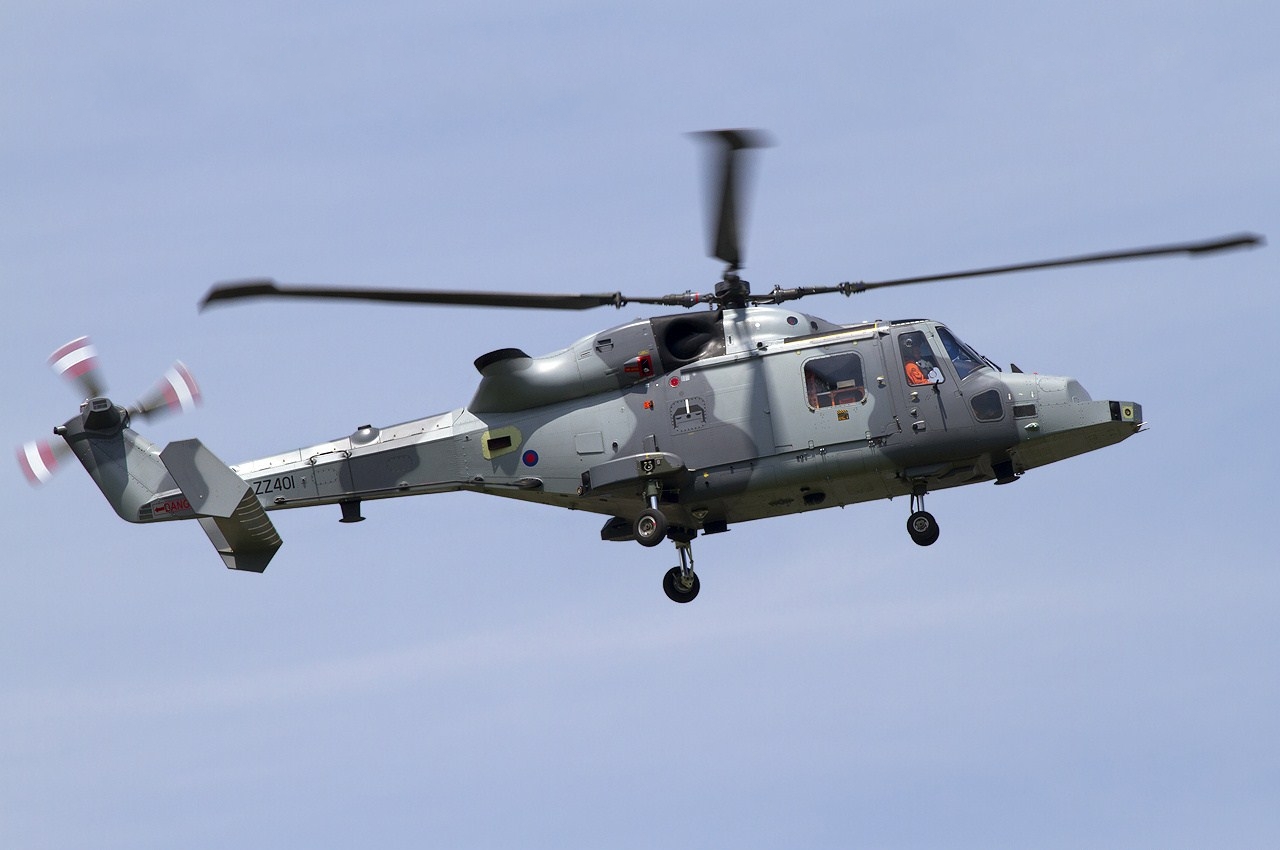
The AW159, earlier acknowledged as
Future Lynx or the Lynx Wildcat, is a new generation naval helicopter, first
inducted into the British Army and Royal Navy services. The helicopter, an
improvised version of the top-notch Westland Super Lynx was manufactured for
hazardous battlefield deployment, CSAR mission as well as ASuW.
AW159 comes out of assembly line
equipped with a semi-rigid rotor head that contributes to the helicopter’s high
agility, matching the operating capabilities of the legendary Lynx helicopter.
In addition to that, AgustaWestland also fits the helicopter with high
performance composite rotor blades, which at one point of history assisted the
Lynx helicopter to break the world helicopter speed record.
The helicopter is driven by two LHTEC
CTS 800-HN engines, each producing 1361shp, with the ability to operate in hot
and high environment. Aircrew operation also is moreover succored by the
integration of four 10”x8” cockpit displays combined with up to date, fully
integrated avionics. AgustaWestland has as well made a decision to manufacture
the AW159 with anti-ship missiles, torpedoes and door-mounted guns, specially
fitted for combat purposes.
The government of
South Korea, on Jan 15 heralded the procurement of AW159 to fulfil its Navy’s
requirement. The selection, according to the Royal Navy, will strengthen their
bilateral relationship with the Korean counterpart. Deliveries which are
expected to commence in 2015 until 2016 will see the helicopter equipped with
various cutting-edge technologies including active dipping sonar, 360 degree
scan radar, nose mounted electro-optical device and a rescue hoist.
AgustaWestland Super
Lynx

The Super Lynx, a multi-role,
multi-mission maritime and utility helicopter by AgustaWestland is presently
operational with various world leading armed forces, a proven fact of its
ability to outnumber other helicopters of similar class. Built with
fully-marinised airframe, the helicopter was designed to withstand the harmful
salt-water corrosion during rigorous sea-operation conditions.
With small ship deployment in mind,
the helicopter was primarily designed with exceptional features including lower
centre of gravity, foldable blades and tail for trouble-free storage as well as
a mixture of other rugged characteristics. In order to operate within the harsh
maritime environment, AgustaWestland came up with the resolution to fit the
Super Lynx with two LHTEC CTS800-4N engines, generating 1361shp capacity,
boosted by a single engine capability. This, in a larger picture, helps support
the helicopter’s operation ability in a demanding hot and high condition
deployments.
The Super Lynx is technically
equipped with an advanced Night Vision Goggle (NVG) compatible cockpit,
integrated avionics suite as well as an array of optional equipments, meant to
enable the helicopter to deliver day and night, all-weather ASW, ASuW and CSAR
missions. The technologies that come along the Super Lynx have been proven to
support numbers of autonomous operation in detecting and prosecuting targets.
Members of ASEAN countries such as
Malaysia and Thailand have chosen the Super Lynx as their superior naval helicopter,
with six currently operational in the Royal Malaysian Navy and four in the
Royal Thailand Navy. The helicopter, along other naval assets has become a key
player in maintaining maritime sovereignty for both countries alike.
Eurocopter EC725

The EC725, a top of the line
helicopter by Eurocopter, also named the Super Cougar is a long-range tactical
transport helicopter, in the beginning developed from the long-standing Puma
family. Surprisingly, despite the primary purpose of land operation utilisation,
the EC725 has become a popular naval helicopter thanks to the various
developments and upgrades by Eurocopter.
Derived from the civilian EC225
model, Eurocopter has deliberately built the EC725 for military use, with a
twin-engine configuration along a spacious cabin, capable of transporting up to
29 soldiers. Despite the noticeably large size, the Super Cougar was designed
to perform multiple types of mission including MEDEVAC and CSAR.
In support of security and self-defence,
the EC725 is equipped with expanded weapons load including two 7.62mm FN MAG
machine guns, an option of two 68mm Thales Brandt or Forges Zeebrugge rocket
launchers, two 20mm GIAT cannons and also the Dassault Electronique EWR-99
FRUIT RWR radar warning receiver. These armaments were intended to come along
the helicopter to ensure higher survival ability in dangerous combat
environments.
At the heart of the helicopter are
two powerful Turbomeca Makila 2A1 turboshaft engines featuring a dual-channel
Full Authority Digital Engine Control (FADEC) system. Driven by both engines,
the helicopter is capable to cruise at a speed of 285 km/h with an outstanding
efficient range of 1339km. The EC725, according to Eurocopter, can also be
optionally equipped with an anti-icing system, a key feature meant to support
very cold climates operation.
Catered for the crew is an
integration package of advanced multi-display cockpit consisting of a hi-tech
display system featuring a digital map as well as the Active Matrix LCD system.
In addition to that, the Forward Looking Infra Red (FLIR) equipped in the
helicopter enables the EC725 to perform day and night CSAR.
The EC725, which has proven its
capabilities with the Brazilian and the French armed forces, is now operational
in the Royal Malaysian Air Force. Currently in manufacturing stage for the
Indonesia Air Force and Royal Thai Air Force, the EC725 is set to be delivered
circa 2014 and 2015 respectively.
Bell 412EP

With the introduction of the 412EP
model, Bell has once again made its presence felt, with purchase agreements by
more than 20 countries, surpassing most of its competitors in term of sale
revenue.
The Bell 412 was developed during the
70’s when Bell converted the up-and-flying 212 model into the 412 prototype.
From the two-bladed 212 model, Bell has radically altered the helicopter with
the integration of the four-bladed rotor thus producing the latter version, the
412 type and it was until recent years that Bell came up with the 412EP
(Enhanced Performance) model.
Featuring the trademarked BLR Strake
and Fast Fin systems, the 412EP model has proven its ability to deliver
improved hovering ability in crosswind as well as hot and high conditions. This
is added with low fuel consumption, a characteristic very important in this
critical period when even the richest country is cutting on military
expenditure. Pratt & Whitney was awarded the responsibility to supply their
engines for the 412EP helicopters and they came up with the PT6T-3DF Twin Pac
engines offering guaranteed Time Between Overhaul (TBO) of 4000 to 5000 hours.
Bell 412EP, through the enormous 2.3
metres door opening has made soldiers and equipment transportation easier.
Added with ergonomic seating configuration, the 412EP is able to accommodate 15
soldiers, including two crewmembers. These characteristics, along with the
adoption of rupture resistance fuel cells, energy absorbing crew seats as well
as the collective mounted throttles has enabled Bell to produce a helicopter
with greater and higher safety limitations.
The Bell 412EP, introduced as a
multi-purpose utility helicopter, has a capability to cruise at a speed of 226
km/h with a maximum flight range of up to 980 km. Weighing slightly less than
three tonnes, the helicopter is a good option for fast and light utilisation.
Latest update in the ASEAN region saw the Indonesian army receiving six Bell
412EP helicopters with an addition of 16 units of similar model with deliveries
expected to complete by the end of 2014. Currently, the Bell 412EP is
operational with various armed forces including the Philippines, South Korea
and Thailand.
AgustaWestland AW109

The AW109 is a lightweight, twin
engine, eight-seater, multi-purpose helicopter built by the Anglo-Italian
manufacturer AgustaWestland. Introduced in 1971 as A109, the helicopter has
proven itself in light transport, MEDEVAC, CSAR and various military roles.
Initially a civilian helicopter, the
A109 has gone through various modifications and upgrades in fulfilling the
ever-challenging military demands consequently resulting the introduction of
the AW109. AgustaWestland has come up with optional engines, either the Pratt
& Whitney PW206C or the Turbomeca Arrius 2K1, both supported by FADEC
system.
The system, supported by a digital
glass cockpit consisting of six digital LCD instrumentation with modern
softwares has help to reduce pilot workload, which in a way grants them the
essential time and space to focus on mission execution. Categorised in a
three-tonne class, the helicopter has a considerably spacious cabin mainly
designed to fit numbers of modular equipments for an easy and timeless
conversion between roles.
Safety measures, like any other
helicopter manufacturers, were critically taken into consideration therefore
resulting the decision to include a fully separated fuel system for less fire
risk, dual hydraulic boost system, dual electrical system as well as redundant
lubrication and cooling system for main transmission and engines.
AgustaWestland has additionally
reinforced the landing gear on all AW109 model for a safer and long-lasting
shipboard operations. Extensive corrosion protection is not left out to ensure
the helicopter’s robustness in maritime settings. These improvements underline
the AW109 ability to perform missions in extreme weathers and environments.
To date, the Philippine Navy, which
is going through modernisation initiatives, has agreed to purchase three AW109
in a process of boosting its maritime security and disaster response
capabilities. The purchase comprises personnel trainings added with initial
logistic support amounting to USD 31.7 million. The decision, according to the
Philippine Navy, was made on many aspects, mainly of its cost-effectiveness.
Delivery is set to take place in 2014.
Eurocopter AS555 Fennec

On January 2011, the Royal Malaysian
Navy PASKAL commandos have executed a recovery mission on a hijacked Malaysian
tanker with remarkable success, supported by the Fennec helicopter. The
mission, conducted against the brutal Somali pirates, saw the Fennec acted as reconnaissance and aerial guardian to keep the
pirate’s ship away from the combat scene. The event made into news headlines
worldwide, with the Fennec portrayed as a key player during the event.
The AS555 Fennec is
a multipurpose military helicopter, manufactured by Eurocopter primarily for
navies’ utilisation. The helicopter was at first designed based on the AS350 Ecureuil and AS355 Ecureuil 2 series and later named Fennec, after the Fennec Fox.
Weighing around 2.8
tonnes, the Fennec is powered by two Turbomeca Arrius 1A
turboshaft engines, rated at 415kW readily
equipped with the FADEC system, enabling the helicopter to perform automatic
sequenced engine starting. Eurocopter has also included two integral fuel
tanks; with 1202 litres fuel capacity, allowing a maximum flight range of
695km.
Beyond that, the helicopter can also
be fitted with a wide range of weapons load to fulfil mission and operation
requirements of many armed forces. The weaponry include missiles, rockets and guns such as the Forges de Zeebruge rocket
launcher carrying seven 2.75in rockets and the Thales Brandt 68mm launcher
carrying 12 rockets. For ship borne operation, the helicopter comes with
ASW and over the horizon (OTH) targeting
features, as well as a chin-mounted Telephonics RDR-1500B X-band, 360-degree
digital colour radar, for search and surveillance application.
In favour of crew
operation support, the helicopter is provided with a night vision compatible
cockpit. This, despite being a common feature in most naval helicopters, is
furthermore adjoined with the Thales
Avionics Nadir 10 navigation system, a Sagem 85 T31 three-axis autopilot and
Thales Detexis RDN 85 Doppler radar.
The AS555 Fennec 2, having served the
Royal Malaysian Navy for the past nine years as multi-role training helicopter
is now still operational, and its newer generation, the AS550 is in operation
with the Pakistan Navy while some are currently in production for the Royal
Thailand Navy.
Eurocopter AS365 Dauphin/ Harbin Z-9

Dauphin helicopter is a renowned
rotary-wing aircraft, having served some of the world biggest armed forces
including the USA and India. Derived from the single-engined, Aerospatiale’s SA
360 Dauphin variant, the helicopter has build up its reputation as corporate transport, airborne law enforcement platform,
emergency medical services (EMS) helicopter, electronic news gathering platform as well as SAR helicopter.
The helicopter,
assigned as navy’s multipurpose helicopter, has gone through rigid
developments, for example the integration of two Turboméca Arriel 2C engines,
accumulatively producing more than 1600shp. The engine capacity contributes to
the helicopter’s performance, with manufacturer maximum speed limit of 165
knots (306 km/h). The helicopter, weighing approximately 2.5 tonnes is capable
to cruise to a total distance of 827km with the service ceiling limited at 5865
metres.
The Republic of China, through legal
licensing process by Aerospatiale, has been given the rights to produce
helicopters based on the original AS365 Dauphin model. They came up with the
Harbin Z-9, a total resemblance of the original model. Through self-research
and development, newer Z-9 models have been fitted with composite materials to increase structural strength as well as producing
lower radar signature.
To date, the AS365 Dauphin/
Z-9, despite the introduction way back during the 70’s are currently still in
production with demands by many civilian bodies and armed forces around the
globe. Record shows that the Dauphin/ Z-9 helicopter is currently operational
with various Asian navies such as Australia, Bangladesh, Malaysia, Saudi
Arabia, Sri Lanka, Laos and Pakistan.


